
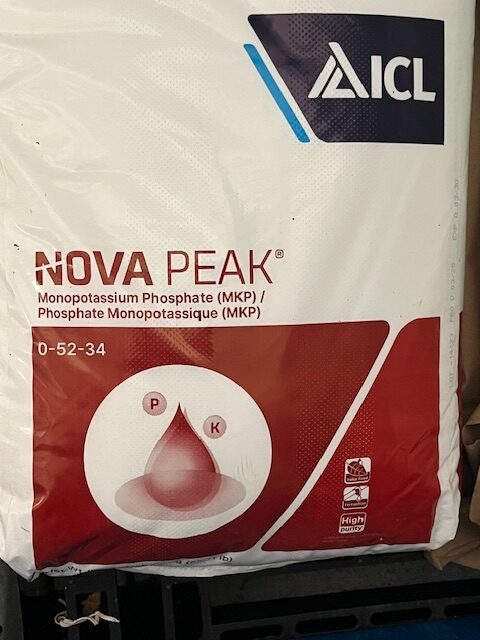
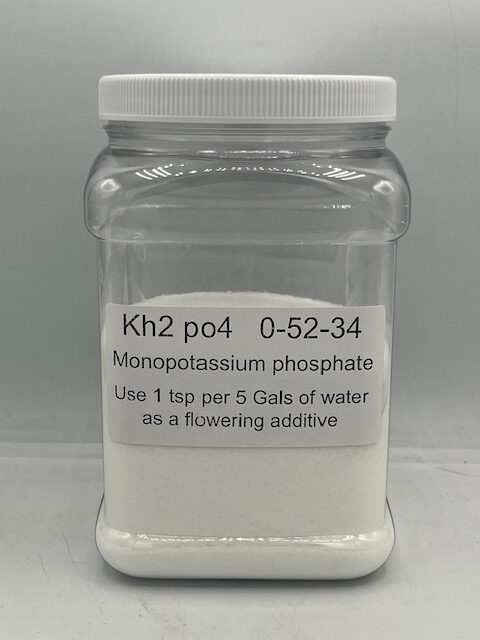
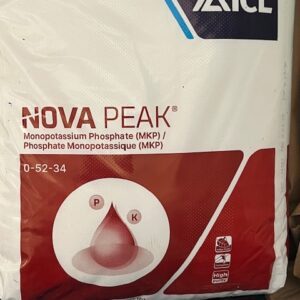
Monopotassium Phosphate Kh2Po4
From $15.00
Monopotassium Phosphate 0 – 52 – 34
Also referred to as Kh2 Po4.
In-store, curbside or delivery!
- Private parking & loading area around back
- Discreet package & labeling on all deliveries
- Minimum 1-year warranty on all products
Monopotassium Phosphate (KH₂PO₄)
Water-Soluble Phosphorus and Potassium Fertilizer
Monopotassium Phosphate, commonly called MKP, is a highly soluble fertilizer that supplies phosphorus and potassium.
Its formula is KH₂PO₄. It contains no nitrogen, making it useful when growers want to increase phosphorus and potassium without adding more nitrogen.
MKP is commonly used in hydroponics, fertigation, greenhouse production, and custom fertilizer programs. It can also be useful during flowering and fruit development.
Key Features
- Highly soluble phosphorus and potassium fertilizer
- Contains no nitrogen
- Useful for hydroponic nutrient programs
- Suitable for fertigation
- Excellent ingredient for custom fertilizer blends
- Useful during flowering and fruit production
- Provides readily available phosphorus
- Provides potassium for plant development
- Suitable for greenhouse and commercial growing
- Easy to incorporate into nutrient recipes
What Is Monopotassium Phosphate?
Monopotassium Phosphate is a water-soluble fertilizer compound containing phosphorus and potassium.
It is commonly abbreviated as MKP. The chemical formula is KH₂PO₄.
Because it contains no nitrogen, MKP allows growers to increase phosphorus and potassium without significantly increasing nitrogen levels.
This makes it particularly useful when fine-tuning a complete nutrient program.
Understanding the KH₂PO₄ Analysis
MKP fertilizer is commonly sold with an analysis around 0-52-34.
The numbers represent:
- 0% Nitrogen
- 52% Phosphate (P₂O₅)
- 34% Potash (K₂O)
These values are expressed using conventional fertilizer analysis.
The actual elemental phosphorus and potassium amounts are lower because fertilizer labels commonly report phosphorus as P₂O₅ and potassium as K₂O.
Always confirm the guaranteed analysis on the product packaging.
Phosphorus for Plant Development
Phosphorus plays an important role in energy transfer within plants.
It is involved in processes associated with root development, growth, and reproductive development.
Phosphorus is also part of important plant compounds involved in energy metabolism.
A balanced supply is important throughout the plant’s life cycle.
Potassium for Plant Development
Potassium is a major plant nutrient with many functions.
It helps regulate water movement within plants. It also supports enzyme activity and overall plant metabolism.
Potassium is particularly important for maintaining strong, productive plants.
MKP provides potassium alongside phosphorus, making it useful when both nutrients are required.
MKP for Flowering Plants
Monopotassium Phosphate is often included in nutrient programs during flowering.
At this stage, growers may adjust nutrient ratios to support reproductive growth.
MKP provides phosphorus and potassium without adding nitrogen.
However, flowering plants still require a balanced supply of all essential nutrients. MKP should therefore be used as part of a complete nutrient program.
Excellent for Hydroponics
MKP is highly soluble and can be incorporated into properly formulated hydroponic nutrient solutions.
Its solubility makes it practical for recirculating and drain-to-waste systems when used correctly.
Water quality and nutrient compatibility should always be considered.
Monitor the finished nutrient solution rather than relying solely on calculated additions.
Suitable for Fertigation
Monopotassium Phosphate can also be used in fertigation systems.
It can provide phosphorus and potassium through irrigation water when properly dissolved.
Before using it in an injector or automated dosing system, confirm that the fertilizer is compatible with the equipment and other products in the stock solution.
Useful for Custom Fertilizer Blending
MKP is a valuable ingredient for growers who formulate their own nutrient recipes.
Because it supplies phosphorus and potassium without nitrogen, it provides additional control over nutrient ratios.
It can be combined with other compatible fertilizer salts to create customized nutrient programs.
Accurate calculations are essential when preparing concentrated stock solutions.
Important Mixing Information
Always dissolve MKP thoroughly before adding it to a nutrient reservoir.
When preparing concentrated stock solutions, fertilizer compatibility becomes especially important.
Do not combine concentrated fertilizer products unless their compatibility has been confirmed.
In particular, concentrated phosphate fertilizers can react with certain calcium-containing fertilizers. This can create insoluble precipitates and reduce nutrient availability.
Best Mixing Practices
- Start with clean water.
- Measure each fertilizer accurately.
- Dissolve products separately when required.
- Follow the nutrient recipe in the correct order.
- Mix thoroughly between additions.
- Check the final solution before use.
- Monitor pH and EC as appropriate.
How to Use Monopotassium Phosphate
Application rates depend on the crop, growing system, water quality, and complete nutrient recipe.
There is no universal application rate for every growing situation.
Hydroponic Applications
Use MKP as part of a complete nutrient formula.
Calculate the amount needed based on the desired phosphorus and potassium concentrations.
Fertigation
Dissolve the required amount thoroughly before applying through an irrigation system.
Make sure the solution remains compatible with the irrigation equipment.
Custom Nutrient Programs
MKP can be used to adjust phosphorus and potassium levels in custom fertilizer recipes.
Use accurate measurements and account for nutrients supplied by all other fertilizer ingredients.
Storage and Handling
Keep Monopotassium Phosphate sealed when not in use.
Store it in a cool, dry location away from moisture.
Prevent contamination of the product and keep the container properly closed.
Moisture can cause fertilizer powders to cake and become more difficult to handle.
Always follow the product label and SDS for specific handling and storage requirements.
Ideal For
Monopotassium Phosphate is suitable for:
- Hydroponic growing
- Greenhouse production
- Fertigation
- Commercial horticulture
- Custom fertilizer blending
- Flowering plants
- Fruit-producing crops
- Nutrient solution preparation
- Potassium supplementation
- Phosphorus supplementation
Product Specifications
| Specification | Details |
|---|---|
| Product | Monopotassium Phosphate |
| Common Name | MKP |
| Chemical Formula | KH₂PO₄ |
| Typical Fertilizer Analysis | 0-52-34 |
| Nitrogen | None |
| Primary Nutrients | Phosphorus and Potassium |
| Form | Water-soluble crystalline fertilizer |
| Suitable For | Hydroponics, fertigation, greenhouse and horticulture |
| Application | Use according to crop requirements and nutrient recipe |
Frequently Asked Questions
What is KH₂PO₄?
KH₂PO₄ is the chemical formula for Monopotassium Phosphate.
It is commonly used as a soluble fertilizer supplying phosphorus and potassium.
What is MKP fertilizer?
MKP stands for Monopotassium Phosphate.
It is commonly sold as a 0-52-34 fertilizer, although the exact analysis should always be confirmed on the product label.
Does MKP contain nitrogen?
No. Monopotassium Phosphate contains no nitrogen.
This allows growers to increase phosphorus and potassium without adding additional nitrogen.
Is MKP good for hydroponics?
Yes. MKP is highly soluble and is commonly used in hydroponic nutrient formulations.
It should be incorporated into a properly balanced nutrient program.
Can MKP be used during flowering?
Yes. MKP can be included in nutrient programs during flowering and reproductive growth.
It supplies phosphorus and potassium without adding nitrogen.
Can I mix MKP with calcium nitrate?
Care is required when mixing concentrated solutions.
Phosphate fertilizers can react with concentrated calcium sources and form insoluble compounds.
For stock solutions, keep incompatible fertilizer concentrates separate unless compatibility has been confirmed.
Is MKP water soluble?
Yes. Monopotassium Phosphate is highly soluble in water.
Proper mixing is still important, particularly when preparing concentrated solutions.
Buy Monopotassium Phosphate from Jon’s Plant Factory
Monopotassium Phosphate is a versatile fertilizer ingredient for hydroponic, greenhouse, and horticultural applications.
It provides phosphorus and potassium without adding nitrogen. This makes it useful for fine-tuning complete nutrient programs.
Use MKP as part of a balanced feeding strategy and follow appropriate mixing practices.
Only logged in customers who have purchased this product may leave a review.
Related products
-

General Hydroponics Liquid KoolBloom
From $39.00Select options This product has multiple variants. The options may be chosen on the product page -
Calcium Nitrate 15-0-0
From $13.00Select options This product has multiple variants. The options may be chosen on the product page -

Pure Blend Tea
From $112.00Select options This product has multiple variants. The options may be chosen on the product page -
7 -11 – 27
$120.00Select options This product has multiple variants. The options may be chosen on the product page

Reviews
There are no reviews yet.